God's always "hooking us," pulling us back: back to the Word, back to the Meal, back to the Font...back to the community.

This blog is for the purpose of sharing around each Sunday's Bible readings & sermon at Shepherd of the Valley Lutheran Church.

Get Sunday's readings here. We follow the Narrative Lectionary.
(In the summer, we return to the Revised Common Lectionary' epistle or Second Reading here.)

So, what's been hooking you?

So, what's been hooking you?


Here you can...

Monday, August 27, 2012

August 26 -- Thirteenth Sunday of the Green Season


I’d like you to try a little exercise with me…just to kind of get our bodies into this Gospel text, to physically orient ourselves to the “words of eternal life”. 

I’d like you to close your eyes and take a deep breath.  [pause] Now I want you to pretend that the world in which we live is all behind you, literally.  It’s behind your back.  You’d have to turn your head to look at it.  All the good and beautiful things about the world in which we live, are back there, behind you.  And all the ugly, broken things are back there too.  I want you to think particularly about the things back there in the world that promise you a better life, a longer life, a more rich life.  (IKEA: “Bring new life to your home.”)  All the things that lure you and perhaps give you temporary joy, but joy that quickly fades…if you’re really honest.  We talked earlier this month about such things – for some it’s food, temporary joy but joy that quickly fades, for some it’s other substances, maybe drink, for some it could be a relationship that’s really not so healthy, temporary joy but quickly fading.  For some of us it’s a compulsive habit, like shopping or collecting or checking FB or email around the clock.  For some of us it’s thrill seeking, for some it’s watching football or baseball – or television shows, or acquiring the latest gadget...Whatever it is for you, it’s “back there”.  Now keeping your eyes closed turn back, literally, as if you’re looking over your right shoulder at it.  With your eyes closed, turn your head as if you’re looking over your right shoulder at those things “back there” that pull at you, entice you, sometimes even successfully seduce you. Do you see it?!  Really stretch your neck, physically turning toward those things behind you.   (If it hurts too much, uncoil and look over your left shoulder, or turn your whole torso…)

Now come back forward and open your eyes…and look at the cross, look at the bible, look at the altar.  Now close your eyes and look back again.  Now open your eyes and look at the cross, the book the altar.  Do that a few times…almost like you’re loosening up before a work out.  [pause] OK…

I don’t know how this made you feel, but maybe it’s a little something like Peter in our Gospel text. “L, to whom shall we go?”  I tried this in my office earlier, looking back and forth, and I don’t know about you, but a few things happened to me:
1) stretched my neck looking back at the world,
2) got dizzy -- (interesting, metaphorically),
3) preferred looking forward with my eyes open

We, like Peter, are always standing at a split in the road.  We could go this way [point at cross], eyes open looking to the cross, or we could go back that way [pointing to door].  And making this choice can be kind of uncomfortable, like a stretch to the neck; it can be dizzying.  But like Peter, we know that ultimately eyes open looking to the cross is the way to go.  As Peter said, “Lord, what other way is there really?  As I look back there, I know everything else comes up short.  Lord, to whom else, to what else shall we go?  You have the words of eternal life…not the IKEA catalogue, not the thrills, or the food, or the entertainment, or the work or the leisure. You have the words of eternal life.”  [pause]

Now, our reading from Ephesians helps us sort all this out a little more:  Because this might sound—this standing with a split in the road (“Do I go this way or that?”)—like I’m getting dangerously close to, what’s called, “decision theology”.  Ever heard of “decision theology”?  This is one of the things that sets Lutherans and some other protestants apart from our other Christian sisters and brothers (this is so important): we don’t make a choice to “accept Jesus Christ”, God always comes to us first…!

[Preach it!]  This place where I’m inviting you to stand with this exercise, this is not deciding to accept Jesus while rejecting the world.  God’s already claimed you…“sorry”.  God knew you in your mother’s womb and loved you way back then and has loved and accepted you ever since, called you by name, held you close.  We might run from it or reject it, but that doesn’t change God’s mind.  There’s no decision you can make about God’s loving, saving and forgiving you.  You have no say in it…AMEN?  Solid Lutheran theology is not “your decision” theology.  Luther: “I cannot by my own understanding or strength (Kraft- force, power, might, agency, fortitude) believe in my Lord Jesus Christ or come to him.  But the Holy Spirit calls me through the gospel, enlightens me with her gifts, sanctifies me in the one true faith…just as she does to the whole Christian church and keeps it with Jesus in the one common, true faith.  Daily in this Christian church the Holy Spirit abundantly forgives all sins, mine and those of all my sisters and brothers!”    

OK?  So we’re not invited to make a choice about accepting Jesus here.  We are invited to go into the world, “armed” to borrow from Ephesians’ imagery, with the truth about what gives eternal life – not all that “stuff” back there.  But rather the words, the life, the death, and the resurrection of Jesus.  That’s what we confess here, this day and every day!

That that stuff back there doesn’t save us.  Jesus does.  So we as people of God, even while we live “in the world” don’t put our trust in the stuff of the world:  IKEA doesn’t bring new life into my home, the stories and songs of God and God’s people do!  Should be a tagline on the bible or on our hymnals: “Bring new life into your home.”  We live in the world, we love the world, but we don’t put our trust in the stuff of the world, in the armor and the weapons of the world, in the empty promises and vain empires of the world.  We who Christ has loved from the beginning are protected are armed only by the truth of the Gospel. 

(interesting picture and great book!)
And fed, by the bread of heaven, which fills us with the true life of God, which nourishes and sustains us for faithful living out there…out there behind you.  We’re not better than anyone:  we’re wearing the shoes of peace and humility.  We’re not violent, we’re carrying the sword of the Word, not the sword of conquest or might.  We’re armed only in that we’re covered by God.  It is a direct counter to the literal armaments of the Roman armies.  It makes no sense to them.  “How could you protected by just God?  You need a real weapon,” the Roman soldiers would scoff.  But we know the truth, we believe, and we trust in God alone.

And so we turn now and go back into the world, full of beauty and pain, and we live our lives.  But always keeping the cross before us – it’s ultimately not the cross or the world.  Christ’s cross is in the world.  And we see it!  We see Christ in the world’s pain.  This is the life of the Christ-ian, the way of the cross, the way of Christ, which is in the world.  There’s nowhere else to go.  “You, Lord, have the words of eternal life.  Cover us with that word, gracious Christ.  Fill us with that bread, loving God.  And help us to proclaim this good word boldly in all our thoughts, words and deeds.”    

Sunday, August 19, 2012

August 19 -- Twelfth Sunday of the Green Season


I think I mentioned this last week, but the 3 of us – your preschool director, your parish administrator and your pastor – sit down in the mornings now for morning prayer.  We use this space right here, we each light a candle, and then we read from the daily devotion: Christ in our Homes.  I know some of you pick up and use that resource (from the narthex) as well.  A few weeks ago, the brief devotional reflection described a man in the choir, who loved to sing.  He was the lead voice on most of the anthems, but he was also a cheerleader, a coach, and friend in the choir group.  He hosted parties for them, gave them gifts and thank you’s, loved the congregation…and then one year, his dear spouse, his life-partner became ill and died of cancer.   The devotion described the funeral service, where the choir sang, but this man was not with them, he was on the front row listening to them.  On this day, he was not able to sing.  He could only mouth the words to “Beautiful Savior” and “Abide with Me”.  And he relied on those, who had for so long relied on him, to do the singing.  And to carry him through. 

That really is a wonderful picture of church, isn’t it?  How we, many times are perfectly able to believe, to smile, to care for each other and to sing.  No problem.  But how dark times come and sometimes we are rendered unable to believe, are unable to smile, and unable to sing.  That’s not surprising – of course we all have good days and bad.  What’s so special about church however, is that, and we might not always realize this – in our good days, when we’re in a pretty good place, and our capacity for singing is full, we might just be carrying someone else through. 
So when we are able to embrace another, whether literally or through song or through prayer, let’s do it.   And at other times we have to let ourselves be embraced, like that dear man on the front row.

Our reading from Ephesians today goes really far and actually ties singing to wisdom, actually to the Wisdom of God.

I find it kind of funny actually that singing is contrasted in our second lesson with drunkenness.   Of all things to contrast drunkenness with: singing?  I’ll be honest, for me, singing and having a few beers is one of my favorite things to do with my brothers.  There’s a young congregation in Denver – maybe you’ve heard of them, called the House for All Sinners and Saints – and they have a bi-annual event called “Beer and Hymns”, which frankly sounds awesome to me.  But here we are challenged to think about what “sober spirited singing” might look like, and I think we need to think about that in more ways than just literally. 

What does it mean to sing spirited songs in full consciousness, in full presence, in full awareness of our neighbors?  Not in some kind of a tipsy haze.  How do we lift one another up, and carry one another through the dark days, the difficult times?   And how do we swallow our own pride and let others carry us, when that time comes?

The gift of church is that it works two ways:  Sometimes you carry the tune and sometimes you’re carried by the tune. 

So be sure to give it all you got, when you can, sisters and brothers in Christ, little Christs.  Be sure to sing out with your life – however that looks.  If you’re a teacher then teach, if you’re a listener then listen, if you’re a coach then coach, if you’re a singer then sing, and if you’re a cook, then we live at 3490 Monique…

God has given us each special abilities and special gifts, and we are called to share those, not just with each other, but with the world, both friend and stranger alike.

And here’s where our Gospel text comes in:  As we are engaged in thing building up of the body of Christ, that is in the mutual giving and receiving of care and song, that is in the sharing of wisdom – Christ is present in our midst, Christ abides with us.  IN the breaking of bread, and the spilling of the cup, Christ’s body and blood tips over into us, and we become Christ’s body for the this hurting world.  This is God ABIDING, for truly it is this one Lord, Jesus Christ who carries us as we carry Christ in our bodies and out into the world.

You are a reflection of God’s love for this world, sisters and brothers.  In all you say and all you do.  In your willingness to reach out, and even in your willingness to be cared for, to be carried, to be sung to, to be hugged, you are a reflection of God’s love.  Feast on that! 

God—thanks be to Jesus Christ—breaks into our lives in the most mysterious of ways.  It’s not just the choir that’s showing Christ to their dear bereaving lead singer.  He shows Christ to them, as he allows them to carry him…
Church works both ways.  Sometimes you carry the tune, and sometimes you’re carried.

Christ is our tune.  Christ is our song.  Christ is our bread and cup.  Christ is our body.  Christ is our earth.  Let us go now, treading lightly, but treading faithfully, from this place, filled to the brim with Christ, on whom we’re about to feast.  Trusting in Christ’s fingerprints and melodies in our everyday lives.  Confident that our present day and our future years rest safely in God’s merciful arms.  For we are the church of Jesus Christ, the bread of life.


Sunday, August 12, 2012

August 12 -- Eleventh Sunday of the Green Season


Our wedding day was a day to remember.  June 25, 2000, Thousand Oaks, California.  From start to finish it’s one of those days on the top of my list.  It was a Sunday, and our families and friends had started gathering in and around our hometown a few days before – Bachelor party was on Friday, Saturday was of course the rehearsal and the rehearsal dinner, and Sunday was the big day. 

Some wise friend of ours – and I can’t even tell you which one – had suggested we stop and take moments throughout the festivities just to take it all in – really intentionally stop and look around or pause and consider all the love and joy that is present.  I had one such opportunity after the Rehearsal Dinner.  The older crowd had all gone home to bed, the younger crowd was out dancing at the restaurant next door to where we had the Rehearsal Dinner, where I had been too, but decided to leave early to get some rest.  I had walked back to the hotel by myself and in the lobby of the hotel were all these Irish folk musicians – this is a random hotel North of L.A., not the north coast of Ireland, but there they were circled up about 30 of them.  The lobby was filled with this beautiful music, so I sat down right in the middle of it to—as our friend said—take it all in, to consider the all the love that was present.  And it was a foretaste of the joy to come.  That was Saturday, the day before I got married.

Then on Sunday, the wedding was scheduled for the afternoon, and so I went to church with my family in the morning.  And we gathered with the faith community around the Word.  Lots of winks and hugs and “see you laters” that morning I remember.  Such a special time and a centering place for me.  I won’t go on and on with the details of the wedding and reception.  But I can tell you, that in the midst of it all there was such great joy and peace that over came us.  The ceremony was beautiful; it was at California Lutheran University’s chapel, where Heather and I had met.  Mark Knutson was our campus pastor and the pastor that married us, so our dads could be dads.  The words and the toasts were all so touching (and appropriately humorous), the pictures turned out amazing, there was dancing and singing – literally: our friends got up and did a rendition of a Jimmy Buffett song in our honor.  We had negotiated to have the hotel ballroom until 1 in the morning, unlike most contracts I understand.   And people stayed late into the night, talking, and laughing and dancing.  We stayed…to the very end.  It was all our closest people at the time gathered in one place.  We couldn’t miss it.

But you know what I didn’t mention in my recollections?  The food.  Traditionally one of the greatest food days in our cultures, and I honestly don’t even remember what I ate for dinner.  I’m sure it tasted great.  And I never even had a taste of our wedding cake.  I know I ate. 

When I look back at it all, I think the real food that sustained me that whole weekend (same’s true for the Rehearsal Dinner) the real food that filled me was the love and the community and the laughter and joy that that had come to gather around Heather and I, as we made our sacred vows to each other.

This is my illustration for our Gospel text today.  And my wedding experience is only a glimpse of the way that God feeds us, sisters and brothers in Christ.  Jesus says, “I am the true bread that comes down from heaven.”  There’s lots to be said of earthly food – and I love it – but when Jesus says he is true bread, we are brought into something much greater than the short-term joy of a good meal or even a wedding feast.    When Jesus offers us himself as the true bread of life, we are offered a place on the dance floor, a seat in the pew at church surrounded by the faithful, a front row to the swirling melodies of traditional reels, with fingers and toes tapping along to the rhythm, our bellies full of laughter, our eyes full of tears, our hearts full of joy, and our minds full of peace.  This is a glimpse of what God’s got in store for us.  And it’s even offered to us now, in this life!  Jesus is here, today, offering himself to us – in bread, in wine, in water, in the community faith and doubt. 

Let us eat of this Bread of Life.  Because it’s so much better than just the bread of lunch or even the fancy breads of dinner.  The Bread of Life gives us the true strength and nourishment and support we need to face our difficult times.

Some of us can actually become addicted to earthly bread, that is, to eating.  It comforts us temporarily, even gives us great joy in the moment, or at least it numbs our pain.  Others of us, if we’re honest, can become dependent on other substances or habits or collections or relationships.  They comfort us temporarily, they even give us great joy in the moment, or at least they numb our pain.  But they all come up short. 

The real bread, the true bread that comes down from heaven, is the Bread that is God’s Love.  God’s love, given for you.

This is the true bread of forgiveness.  And it is held out to you. 

This is the true bread of justice and compassion – the ability to open your heart and care for the alien and the stranger, the immigrant and the orphan, the hungry and the diseased, and anyone who you thought you could never like – This is the true bread of justice and compassion, and it is offered to you this day. 

This is the true bread of joy and peace.  Calming our anxieties and our cravings for more.  Bringing a smile to our faces and air to our lungs.  And it is offered to you this day.

Let us take this bread together.  Let us break it and share it.  Let us eat it in community with the whole earthly community heavy on our hearts in prayer.  For this is the true bread of heaven that raises us all up on the last day, that draws us closer to God and therefore to one another and closer to the good earth.  Take and eat, this is the body of God given for you…and for many.  AMEN.


Sunday, August 5, 2012

August 5 -- Tenth Sunday of the Green Season


Grace to you and peace from our Lord and Savior, the Bread of Life, Jesus Christ.  Amen. 

Well, I was trying to fall asleep last night…so I watched a documentary.  The problem is, I love documentaries.  This one was done by PBS, whose documentaries are always excellent, and it was called “This Emotional Life”, a three-part serious on the psychology and sociology of human emotions. 

And in it I was reminded once again of that famous study they once conducted on chimps – poor chimps – they took baby chimps away from their biological mothers, and installed two “fake mothers” in their habitats – one made out of metal wire, who had food, and the other made out of fluffy warm fur, who had no food.  Which “fake mother” do you think the baby chimps picked? 

Every time those little babies opted for the comfort and warmth of the fluffy fake mother figure, which the scientists concluded suggests that emotional nourishment might just be a higher priority than even physical nourishment.    

It reminds me also of one of these backstories I’ve heard while watching the Olympics.  (Heather and I have just loved watching the Olympics this year.)  And I’m not sure if you heard the backstory on swimmer Missy Franklin:  Apparently she opted out of moving away to be coached and trained at some highly advanced facility with the greatest coach in the universe (some “wire structure with milk”), and said she’d rather stay close to her friends and family, have a normal high school experience, and be on the high school swim team.  And I heard her say in that interview, “You know, I probably wouldn’t be where I am today if I had left because I just wouldn’t have been happy, and all that affects my performance.”

The people in our Gospel text today are tailing Jesus again.  He just fed them, all 5000 of them, but they’re back.  (Reminds me of my kids, “I just fed you, but you’re back!”)  Of course they’re back: one miraculous meal doesn’t cut it.  They’re looking for daily bread.  “Give us this day our daily bread.”  Jesus, we need to keep eating and one amazing meal, just doesn’t cut it.  We too are looking for daily bread.  Lord, give us this bread always.

And, in the Gospel of John, when the people come clamoring for a sign, when they have rejected the fake, metal structures of this world, things that might provide a little immediate sustenance or pleasure, but no long-term, emotional or spiritual nourishment, when the people come clamoring, Jesus gives them…HIMSELF.

I am the bread of life.  Come and believe in me,” he says…

Jesus is the Bread of Life.  So that even friends and family to provide everything we need, comes up short.  Let’s remember, not everyone has friends and family.  There are orphans in this world of all sorts, solitary types, with no one to write in as their emergency contact.  Not everyone is as lucky as Missy Franklin or you, perhaps, nurtured and nourished by a loving home.  So that illustration falls short.

For this Gospel, this Jesus, this Bread of Life is for everyone, not just those who can relate to a loving home and a big loving and supportive family!  Christ gives the true and greatest nourishment, relieving all hunger and quenching all thirst.

So, I don’t know about you, but I hunger and thirst for peace in this world, for an end to violence, for our children to stop pretending to shoot one another, for our soldiers to come home from war, for our homes to be safe and warm, free of abuse and domestic fighting. 
That’s just one example of what I hunger for…and Jesus says, “I am the Bread of Life.”  In other words Jesus offers himself, when I come clamoring and hungry.  “Look to me,” Jesus says, “follow me, eat me – my body my blood – and peace will come – maybe not in the way you first want, but rather it starts from within—that peace you desire—and it sends you out.  I am the bread of life,” Jesus says.

For what do you hunger this day?  I’m anxious and restless about a lot of things, so am I able to hear Christ’s gentle words?  “I am the bread of life, given for you, even and especially now.”

Today we also get Part 2 of David and Bathsheba…[retell the story] 

“How could someone do such a thing!” David says in self-righteous judgment.  Do you ever catch yourself sounding like David here?  “How could someone do such a thing!” we can say in self-righteous judgment.  I probably sound like David in this great story, every time I watch the news.  “But I’m talking about you,” Nathan responds. “But I’m talking about you,” the prophet responds.  And then he realizes it.  Can we too realize it? – the trash on the ground, the trash in the air and in the water, the violence all around, the recklessness and selfishness and entitlement and fear of our nation and our world and our own psyches?   It’s on us, just like David, it’s on us as a human family – it’s the world, the culture we’ve created, with trash and violence, it’s a reflection of our own broken, sinful and violent natures.  We are the ones, like David.  You are the one, like David.  The prophet just holds up the mirror.

And that’s a hard word to hear.  “I don’t like this prophet!  Telling me that I’m responsible for this mess!”  That’s why we always kill the prophets, or at least dismiss, the prophets as “out-of-touch” or “unrealistic”.  Crazy old man, Nathan!

And here’s where the great and fallen King David is so instructive, such a gift to us on our journeys:  David manages in all his pride and recklessness, from his seat of power and privilege, David manages to open his ears to the prophet’s words, to see the mirror the prophet holds up, and then he melts, and then he repents. 

Not only is David’s sin one of the greatest in the Bible, so is his admission, confession, and his repentance: “I have sinned against the Lord,” he says, bowing his head in humility and shame.  May we too have that kind of honesty before God.

And here’s what happens next (for some reason it’s left out of our assigned reading for today): Nathan’s response to David. “Now the Lord has put away your sin.  You shall not die.”

David was able to receive both the God’s words of conviction and then God’s words of forgiveness. 

There is Christ.  There is daily bread.  Forgiveness.

No other bread will do – not the bread of money, not the bread of success, not the bread of arms and security, not even the bread of family and friends.  They all come up short… 

Eat of this bread of forgiveness that is Christ.  Eat of this bread of truth that is Christ.  Eat of this bread of peace that is Christ.  Eat of this bread of life that is Christ.  AMEN.

Monday, July 30, 2012

July 29 -- Ninth Sunday of the Green Season


You know, not every Sunday lesson is for everyone…in the same way.  Sometimes the lessons hit you and they seem to be exactly the Bible passage that you needed to hear, bringing comfort, offering forgiveness or issuing a timely nudge.  Other times, the texts might seem “a stretch” for you.  Still other times, you may find lessons that you didn’t think you needed to hear, yet God once again surprises you… 

So how about today:  David and Bathsheba, and the villainous murder of Uriah (which of course is part of the ancestral genealogy that leads to Jesus’ birth).  What could such a tragic and scandalous text have to do with your life?  Or what about this text about the generosity of one little boy amid the selfishness of the multitude and the anxiety of the disciples? 

What jumps out at me – and this may not fit with where you are – but what jumps out for me is God’s voice and God’s action in the midst of abundance.  We often talk about God when things are bad.  People come flocking to the church, when there is crisis, or death, or scarcity.  But what about when we’re doing pretty well, or even great? 

Have you ever been there?  Have you ever had a moment to look around you, to look at your life, and say, “You know, I’ve got it pretty good.”  That’s why this text—or at least my read on this text—might not be for everyone.  I realize that some of us have never really been able to say that.  For life for some has been one tragedy after the next.  There’s certainly something to be said for God’s voice and God’s action amid the suffering and pain of the world, but today, I want to call out those among us who have ever had a chance to look around and say, “You know, it’s not that bad.  You know, now that I think about it, my life is pretty good – I’ve got food in my tummy, air in my lungs, a friend, a pet, a hug coming my way, a beautiful sunset out my window.  Things are pretty good.”

Today’s texts are about God’s voice and God’s action in the midst of abundance and blessing.

My hunch is that King David was feeling pretty blessed, I mean, he was certainly taking a moment to “look around” in our Old Testament lesson.

When things are pretty good, or even great, there are two ways that we can falter, according to our readings today.  The first is to start get reckless and entitled, like King David.  We humans are capable of some terrible things (particularly when things are good), and I’m not sure, if given the kind of power David had, many of us would be able to withstand our own greatest temptations either.  He did it because he could.  He even had Uriah killed because he could, and he needed to cover this up.  What is it that you’d go after, if you had all the power and money to do so?  Honestly.  What lures you?  And who might be forgotten in your pursuit?  Would those with no voice be remembered?  The poor, the earth?  Who cares about others when I’m going after what I want, right?  If you’re above that urge, then you ought to be preaching our sermons here.  David is not so different from us; we see ourselves in him, unfortunately…

When things are pretty good, or even great, we can get reckless and entitled, like King David, in hot, tunnel-vision pursuit…

…or we can get anxious and scared like the disciples in our Gospel text. 

There Jesus has just given them a sign, the feeding of the 5,000.  Just think about that for a moment:  When we volunteer at T.A.C.O. it takes us an hour and a half to serve about 170 people.  And that’s a lot of food.  Jesus serves 5,000!  Now that is an awesome God.  And I’d encourage you to have the faith of a child on this one:  I tell that story to our youngest children, and they just take it on faith.  (Oh yeah, he walks on water today too.)  At some point—and it’s happening sooner and sooner—we get this need to explain away the miracles.  Try to hear this story with the faith of a child.  Jesus feeds 5,000 and then he walks on water.  Bask in the truth of that!  

"And 12 baskets left over…" 
And now consider the disciples, they were anxious about all “those” people, I mean that would be like – Philips quick math – six month’s wages.  I don’t care if you’re blue collar or white collar – six month’s pay is a lot of money.  But Jesus does it!  He feeds 5,000…with 12 baskets of leftovers!

Scene two: Only hours later:  A storm comes up and the disciples are afraid.  Anxious before the abundance and “terrified” after.  In the midst of God’s abundance, 12 baskets overflowing just hours ago because of Christ, the disciples get scared. 

Sisters and brothers of Shepherd of the Valley, I don’t know if we have exactly 12 baskets overflowing, but we have an abundance here.  We have bread.  We have able bodies.  We have love and concerns and passions.  And we have money here.  Part of it is in your own pockets and in your own bank accounts, part of it is in the church’s bank accounts, with the bequest, with the preschool, with our tithes and our offerings – but we have money here.  Which means we get scared and anxious.  And we want to protect it, and keep it and fix ourselves up nicely, our children up nicely, our carpet up nicely, our kitchen up nicely, our garden up nicely.  Just hours after Christ has “taken the loaves, blessed them and distributed them” and there were 12 baskets overflowing!  Oh, we can relate to those disciples.  Anxious before the abundance, and terrified after…

But friends in Christ, all that we have and all that we are, comes from God and belongs to God.  So help us, God, to be faithful with your abundance!  And God recognizes our fears and our anxieties, our entitled attitudes, our greed, our recklessness, our need to protect ourselves at all costs.  And God holds us in love, as we journey through all those feelings.  God hears our confessions:  “Yes, we’re scared.  Yes, I’m selfish.  Yes, we can be reckless and act like we deserve all this.” And God holds us in love as we get knocked around by the waves of this life…as the tragedies and pains of this world try to erode away our trust in this God, and so easily we forget who multiplied and blessed the loaves.  But God holds us in love through it all…God holds you.  But there’s more…

But there’s Ephesians today: A prayer:  that we be “strengthened in our inner being with power through the Spirit, that Christ may dwell in our hearts through faith, as we are being rooted and grounded in love.”  Not only does God holds us in love; then God roots us, God puts us down into the soil of this earth, in love, so that we may grow outward.  God waters us, nourishes us, and up and out we grow.  We Christians are held by God, planted by God, and tended by God, through the Spirit.   We Christians are rooted and grounded in agape.  And so, we don’t need to be afraid…this day or ever again.  For God feeds us…with the “bread of peace”.  AMEN.

Sunday, July 22, 2012

July 22 -- Eighth Sunday of the Green Season


Micah and Katie at a rest stop just south of Portland, OR
Grace to you and peace.  I want you to do something with me that we haven’t done for a while.  Inhale grace, exhale peace.

Sisters and brothers in Christ, last week we had a difficult text where Jesus bids we come and die.  I started out the sermon by saying, “I don’t know that I’d be willing to die for Christ,” and we pondered martyrdom as we remembered John the Baptist, who was willing to die for Christ. 

Discipleship is not easy, we were reminded last week.  And it looks like this week is part 2, a fine compliment to the cost of discipleship:  this week it’s the joy of discipleship.  Both are make up the Christian journey.  This week Jesus invites to come away and rest a while.  A beautiful summertime text.

When we first looked at this Gospel text as a worship planning team months ago, I started dreaming about bringing a massage therapist in.  Actually called Beth Buller, but I didn’t follow up, and I’m glad I didn’t.  But think about that for a moment: Consider massages or pedicures or a day at the ballgame or an afternoon in the garden (however you relax) as not just as a treat to yourself, but as a very gift of God.  This is part of our text today.  God offers you hard-working people grace and joy that looks like retreat: come away and rest a while.  To get in a boat, literal or figurative, and sail away for a while.  Sabbath.  Rest.  Worship.  Joy.  They’re all wrapped together.

I said I’m glad we didn’t follow through on the massage thing, not because I don’t think it would be awesome and really drive that message home (imagine someone massaging your shoulders)…but because it’s not the whole message. 

You look around our culture and you see plenty of people going away and resting.  Perhaps for more than just a while.  A recent study found that Americans spend $11 billion every year on massages (wiki.answers.com).  And here’s what the average household in 2009 spent on fees and admission to sporting events and other types of entertainment: $628 (topstockanalysts.com).  Average.  Just getting a massage, just going to chill out, is not the whole message.         

It’s never an either/or for the followers of the Good Shepherd.  We are called to care for both ourselves and the world around us.  The message today, as one of our worship planners pointed out to me, is much deeper than a deep massage. 

What Jesus is really saying is not just, “Go get a massage, go rest a while,” but rather, “Rest in me.”  Rest in my arms, no matter what you do.  Be still, be calm, inhale grace, exhale peace, and trust in my love and my promises…whether you’re working or playing.  Treat yourself…and then turn and treat the world, treat the stranger, treat your enemy…and then treat yourself again.  And keep treating…a cycle of treatment.  That’s discipleship: getting caught up in this good cycle of treatment and care.

What’s funny is when care for yourself and care for the world gets intermixed.  When service and retreat are all part of the same thing.  I think we find that when we volunteer, whether it’s at a hospital or at Third Avenue Charitable Organization downtown, or tutoring your neighbor.  When we break from our regular routine and go help someone else, it’s a blessing to all, including to ourselves…it’s even care for ourselves. 

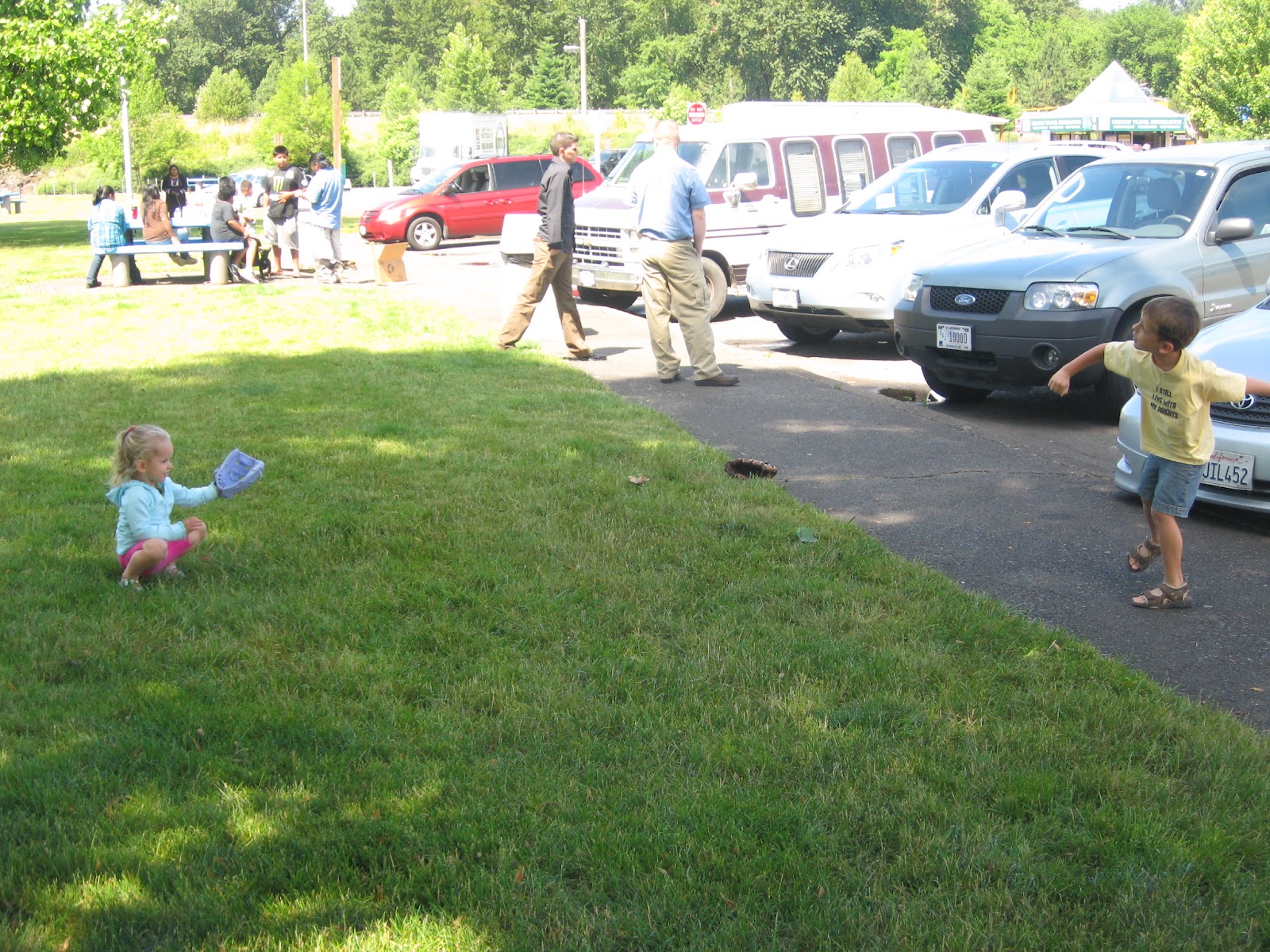
Many of you know that my family and I went on vacation about two weeks ago.  Drove up the coast to be with family and friends in Oregon.  And one of the joys of travelling on the road (for the last couple years) with 2 small children has been stopping at rest stops.  I don’t really remember rest stops growing up, and I never used them as an adult, before kids.  But I have discovered rest stops.  (Think about today’s text and rest stops.)

What occurs to me, about those really fun stops that we make as a family, is that rest isn’t really part of what we do there.  In fact it’s the opposite: when you’re cooped up in the car with kids, we all want to run and play at the rest stops.  And we do: whiffle ball, Frisbee golf, tag, riding scooters, some even with playgrounds and small baseball diamonds.  We love rest stops, and I think about all the different ones we’ve been to…some with beautiful vistas, some with great open spaces to play, and some with much needed shade.  And it’s not like I’ve never stopped and put my feet up at a rest stop either.  It’s all of the above!  

Where am I going with this?  When Jesus calls us, it’s all of the above.  It’s both massage and sweat.  It’s both baseball game and work over a hot stove.  We rest in Christ’s arms, and so there is peace, no matter what we are doing. 

Peace for Margaret and Jane, for ultimately they rest in Christ’s arms.

Peace for our 35,000 ELCA who have been in NOLA this week for the National Youth Gathering…

Peace for our soldiers, both home and away, and for all who find themselves in harms way, for ultimately they rest in Christ arms.

Peace for all affected by the terrible shooting this week in Aurora, Colorado…even while it might not seem like it.  For ultimately they rest in Christ’s arms.

Peace for all who labor away this summer, perhaps longing for a literal rest stop.  But ultimately they rest in Christ’s arms.

Peace for all who travel and play, for no matter where they are in the world, ultimately they rest in Christ’s arms.

Help me for a moment and preach the Gospel to your neighbor and turn to them and tell them.  “Peace to you, for ultimately you rest in Christ’s arms.”

And there is peace for little Nicholas, as he is carried to the waters of new life at the very beginning of his new life.  And washed in the waters, marked with the oil, with the cross of Christ, that peace goes with him for his entire life, no matter where he goes or what he does.  Isn’t that amazing?!            
 
This is not a text about resting and taking a break; it’s a text about peace.  The deep and lasting peace of God which never leaves us, even if we try to leave it.  “Oh give thanks unto the Lord for God is good, and God’s grace and mercy endures forever.”  God’s peace is a lasting peace, and because of it, all are welcomed into the fold, all are given a place at the table, all are freed to be the people God has called them to be.  It’s impossible to fully comprehend God’s peace, resting in Christ’s arms, so we just trust it.  This is life in the faith.  Welcome to it, little Nicholas! 

May this peace of God, which passes all human understanding, keep your hearts and minds in faith in that Christ Jesus, this day and forevermore.  AMEN.   

Thursday, July 19, 2012

July 15 -- Seventh Sunday of the Green Season


I don’t know about you, but I don’t think I’m really willing to die for my faith.  Just being honest.

I was hoping I could come back to a more gentle text today.  This one is a tough one, and invites us to think about some ideas that we probably don’t have the opportunity to ponder, nor would we like to, very often.  Martyrdom – John the Baptist, decapitated for his discipleship, for his willingness to speak the truth, caught in a world of seduction, power and violence. 

Are we willing to die for Christ?  Sometimes I think I’d be more ready to die for my country than to die for Christ.  Dying for Christ just sounds so nebulous in our day in age.  What does that even mean?  What would it look like for you to die for Christ?  When was the last time anyone asked you that? 

I want to invite you this week to pray over this question of dying for Christ.  “Lord, what does it look like to die for you?  Because I’m confused and I’m scared, and I’d rather just go back to the world.  But what are you calling me to do?”  I’m not totally convinced that we’re all called to go charging into today’s equivalents of King Herod’s courts.  But I do believe we are called to ponder, at the very least, this idea of speaking truth to power.  Truth to wealth, truth to luxury, truth to prestige, and truth to ignorance and apathy.  God’s truth to “the way it is”.  What does that look like?

One of our resources for today, suggests that the most tragic character in our Gospel text is not John the Baptist, but Herod the King.  John’s message about repentance and his pointing to Christ lives on, despite his death.  But King Herod just becomes yet another fallenruler in history.  Herod never got it. 

He fell for the temptations and seductions of this world.  He went back to the world.  And it’s a raunchy story.  This “daughter” of his dancing in front of him, Herod being caught up in it, making a promise to give her whatever she wanted, almost like he was in a trance, the mother’s desire to kill John the Baptist, and that gruesome image of his head on a platter.  Ugh.  At first glance I wonder if we can even relate to this stuff.

But then I think, well, we sure can fall for the temptations and seductions of this world.  As much as we try to put ourselves in John’s shoes, we often find ourselves in Herod’s.  What is it that tempts or seduces us?  There are certainly some obvious sexual connotations in this story, but there are many ways that we can be lured away from following Christ.

Micah asked us a while back while we were having a special treat, ice cream or chocolate or something:  “Daddy, why are things that taste so good, so bad for our bodies?”  I think that’s the question, isn’t it?  Why are things that are so much fun, or so simple, or so affordable, or so tasty…so bad for our bodies?  [pause]  And not just our own physical bodies?  So often,as we indulge, we can hurt others—perhaps unconsciously—the whole human family, the body of Christ, or the earth, what some theologians have called the Body of God.

Yesterday after visiting Margaret Sunde, I went to buy some new shorts.  And only after I bought them, because they fit me and liked the color and the price, only after I indulged did I look at the label “Made in Bangladesh” and I looked up the company that made my shorts, and couldn’t find anything about the conditions of the factories in Bangladesh.  But I gave money to that company yesterday, as if in a trance, and I suppose I gave a boost to economy in some tiny way, created jobs and all that, but I would be pretty surprised if the conditions for those teenage girls in Bangladesh who sewed my shorts together are very healthy and positive.   

There are some powerful forces in this world.  And it’s all very complicated.  Sosometimes it’s good to have a text that lays out the two ends of the spectrum, just to help us get our bearings…today we see two extreme characters:  John the Baptist and King Herod.  “Lord, give us the courage and the faith to be more like John.” 

“When Christ calls us,” as Dietrich Bonheoffer once said, “he bids we come and die.”  God, give us the courage to risk our lives for your sake.  Give us the words to speak what needs to be said.  Give us the eyes to see those who have been forgotten.  Give us the ears to hear, and the hands to reach out.

Friends, Margaret Sunde, our sister in the faith, is dying.  She’s in hospice care, and it’s only a matter of time.  And as I was saying good bye to her yesterday (I plan to go back again today), but I was leaving she reached out to give me a hug from her bed.  Now you have to understand that she has difficulty moving her arms at all, so when she reached out her arms and lifted her feeble arm around my neck as my able body leaned over her bed, I couldn’t believe it.  And I was struck by this thought and this image:  that even on our deathbeds we can still reach out.  And that reaching out is Christ.  Yes it was Margaret hugging me yesterday, but it was also Christ showing me love and joy with all evidence to the contrary.  With such a dear woman dying in my arms.

This is the love Christ has for you too.  The crucified Christ’s feeble arm wraps around us, even and especially in our King Herod moments, even as we fall short, and get lured away.  Christ reaches out his hands to us and offers us forgiveness, calls us back, bids we come and follow even if it means death, and promises never to abandon us.  For in Christ, death is ultimately conquered forever.  AMEN.