God's always "hooking us," pulling us back: back to the Word, back to the Meal, back to the Font...back to the community.

This blog is for the purpose of sharing around each Sunday's Bible readings & sermon at Shepherd of the Valley Lutheran Church.

Get Sunday's readings here. We follow the Narrative Lectionary.
(In the summer, we return to the Revised Common Lectionary' epistle or Second Reading here.)

So, what's been hooking you?

So, what's been hooking you?


Here you can...

Sunday, January 25, 2015

January 25 -- The Beatitudes


Blessed are they who have lost something or someone.  

You know, if we’ve heard this passage many, many times -- as many of us have -- the gift of it is that we can hear different emphases each time, depending on where we are in our lives.  

I think, that in this, Jesus’ Inaugural Address (he’s only said about 5 one liners up to this point, but now he’s about to go on for 2 chapters).  A few short verses before this, and we see that he has indeed begun his ministry -- he’s called his disciples and he’s begun healing multitudes of people and casting out demons.  But now he stops that, climbs up a mountain side so that everyone can see and hear him, and he begins preaching.  And in this, Jesus’ State of the Union Address, he is drawing the whole community of disciples together through a common experience of loss, it seems to me.  Everyone has experienced grief and loss at some level.

Blessed are those who have lost something, those who mourn: he flat out says it too.

But those who are poor in spirit, they’ve lost something too.  They’ve lost hope, they’ve lost that spark, they’ve lost the twinkle in their eye and the pep in their step.  I saw ‘Selma’ this week on MLK Day in fact, and I was reminded again of the hundreds of thousands of African Americans who had been beaten down by racism for so long that that spirit -- if it’s not lost altogether -- is certainly
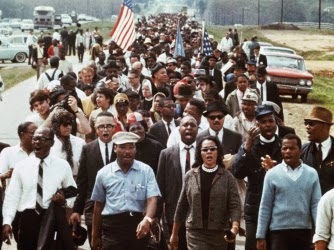
threatened and tested.  It would probably be easiest just to give up, don’t you think?  But through leaders like the great and famous Martin Luther King, Jr. and so many others, they clung to these words -- blessed are you.  And I know that King drew so much of his preaching and inspiration from this Sermon on the Mount.

(It’s amazing to pause for a moment and consider this sermon of Jesus inspired so many through the Civil Rights era, and many other critical moments in history, right up to today...)

Do you ever feel poor in spirit?   Are you ever feeling washed up and out of hope?  Jesus calls you blest, even in your state of loss and grief.  Blessed are those who have lost their spirit, their joy, their imagination and their dream.  Christ has a word for you!

Those who are meek, have lost something too.  They’ve lost power.  They’ve lost their place in line.  They’ve lost their seat and their say at the table.  Perhaps they never had it.  But they are blessed, according to Jesus.  Those who are at the margins have Christ at their side.  Those who are on the edge of poverty, living paycheck to paycheck, no time to even get their voice into the mix because they’re just trying to pay the rent, feed their kids, help them with homework, and then collapse to bed in order to do it all over again the next day.  Something has definitely been lost, and yet Christ calls them blessed.

And those who hunger and thirst for righteousness, those who are longing for the world and for themselves too to synch up words and actions.  That’s what righteousness is.  When you say one thing and do another your heart is divided.  But when you are righteous, when your words and actions line up and your heart is pure, God smiles and calls you blessed.  But those who hunger and long for this state of things are called “blessed” as well!  There is blessing simply in the “longing for”!  
If you simply desire and pray for the world and for yourself to be pure heart, righteous, peaceful, you are called “blessed” by Jesus!  
Let’s spend our time longing for peace, righteousness, mercy in our world and in our hearts! [pause]

The sermon goes on -- there are more who have experienced great loss -- those who are persecuted, those who are made fun of for their beliefs and their practices, those who go to church (like us), and those who don’t go to church -- those who are reviled.  The losses here are immense.  If you’ve ever been made fun of, you know the sense of loss that comes with it.  Youth are terrified of this and driven almost completely by it.  Rejection is an incredible loss.  We all want so badly to be accepted at some level, into some kind of community.  And there is deep, abiding pain, when we experience rejection, ridicule, peer pressure, bullying.

Well Jesus has a word -- and a community -- for those who get made fun of in the cafeteria line, in the locker room, on the bus, and into adulthood -- Jesus calls them blessed, even in the loss they’ve experienced.

This in itself is profound -- that God would name us blessed in those moments that the world only sees a loser.  [slowly] This in itself is enough to carry us through our darkest days.  This in itself is enough -- this strong word of God -- carried those marchers from Selma, Alabama to Montgomery.  Over the bridges of hatred and discrimination and violent abuse.  This strong word of God -- “You are mine; and you are blessed” -- is in itself enough to bring us through our troubled times.  

But I want to connect this word “blessed” back to the Old Testament:  You remember God’s promise to Abraham and Sarah?  “I will bless you to be a blessing.” Do you remember that?  
And we saw a few months ago, when we read this text, that blessing is not associated with the world’s view of success -- Abraham and Sarah, we learned were doing pretty well in the world’s eyes -- they had lands and cattle and employees and businesses.  But God didn’t name them as blessed until after they gave up their faith in all that, and went to a new land.  
Blessing doesn’t have to do with wealth and prestige, it has to do with being in a relationship -- a right relationship with God and a right relationship with the world.

So when Jesus calls us blessed, when we’re down and out, when we’ve lost, Jesus is inviting us to connect, to build community with those around us, who are hurting as well.  (I think this theme of community is so deeply imbedded in Matthew’s gospel.  What it means to be church.)

I heard a funny story again recently about this wacky “rabbi” living in Jerusalem who likes to have people over to his home and teach them, and who believes -- flat out  -- that he has all the answers to life’s problems.  One of his answers is this though -- “If you’re feeling sad and hopeless about your life, look around and find someone else who’s in a tough spot.  Help them out.  And I promise you, I promise you, I promise you, you’ll feel better.”  [pause and repeat (?)]

Blessed...to be a blessing.  Blessed are the poor in spirit...to be a blessing for others who are poor in spirit.  Blessed are those who hunger and thirst for righteousness...to be a blessing for others who hunger and thirst for righteousness.  [pause] We are lost looking at others who are lost.  Broken to be with others who are broken.  Hopeless but sitting right next to others who feel hopeless.  


In our wounded-ness we find healing, in our sorrow--when we look around and open our eyes and our ears--we find joy...through Jesus Christ, who invites all the downtrodden into lives of discipleship and service -- which is always wrapped up in community.  Blessed are those who mourn for they will be comforted.  Blessed are you when something that matters in your life is lost.  God is with you through it all, and not everything is lost...for in your darkest, saddest, most depressing moments, Christ is handing you the kingdom!  Christ is offering you the hope of the ages, the life of the universe, the joy of Lord.  You are blessed too.  AMEN.

Sunday, January 18, 2015

January 18 -- Tempted in the Wilderness


I’ve been working on projects this new year.  Been doing some painting, some repairs around the house, some art projects too -- a side of me that’s been neglected for a while.  And I’ve been organizing pictures -- almost 14 years of pictures -- about a 1000 pictures a year.  And so I’ve been reflecting back...

And one of my favorite series of pictures in our collection is our move to Chicago.  Heather and I had a comfortable life in Thousand Oaks.  We got our first apartment together right after we got married, we had comfortable life -- friends and family all very close by.  And then I decide God is calling me to go study theology, maybe even be a pastor.  And we spent 1 of those 2 comfortable years visiting schools and job options for Heather, and we finally decide on Chicago.  Which means we have to pack up all our things, and move to the Midwest.  I love our pictures of last suppers with different groups of friends.  Some of the church members where I had been working as a youth director showed up and helped us get everything into the truck (not quite sure what to make of all that now ;)  And then after all that time and preparation we drive the Uhaul truck, towing our only car literally across the country.  It was so exhilarating and frightening all at once.  Great pictures documented our journey.  And our first hurdle was to cross the desert in July.  I’d never driven a giant Uhaul truck at that point, never towed anything, and was so worried we’d get stranded in record heat.  But we made it.

Here’s what I want to say:  If you want to go to the fertile green, rolling hills of America’s bread basket, corn country -- Illinois, Iowa, Missouri, Nebraska -- you have to go through the desert.

Jesus had to go through the desert too.  This text comes to us this year, not at the beginning of Lent, like it normally does -- but this year we hear it in the order of the Gospel of Matthew.  We’ve just been working our way through, and right after Jesus’ baptism (last Sunday) it says, Jesus is led into the desert.  

Last week I talked about how Jesus gets down in the deep waters, the deep pain and sorrows, the deep humanity of our reality.  And this week that continues as he gets down into the deep temptations, tested...in the wilderness.  Last week Jesus is named the Son of God.  And this week, the devil -- Diabolos in the Greek, which literally means the Thrower of Obstacles or, I’d say, the Tripper -- the devil doesn’t miss a beat and says, OK, if you’re truly the “Son of God” then...

Last week was wet.  This week is dry.  Jesus goes through it all.

And Matthew, the Gospel writer, is centering his audience on this great theme of double-mindedness.  It’s pretty easy to fool everyone that you’re righteous -- that’s true for all of us.  For one thing, just get baptized right?  Do good things.  Be humble and kind with your words (and your Facebook posts).  Lead an upstanding life, be faithful to your spouse and your children.  Vote.  Go to church.  Pray at meals.  Support public television.  Adopt a family at Christmas.  And if any recognition or praise is ever passed your way, duck it, say something humble, and flip the praise onto someone else.  Classy.  We’re pretty good at fronting, showing the world how righteous we are.  (I think I do a pretty good job of it.)

But if we take the world’s eyes and commentary out of it.  If we strip away all those voices of praise and pressure, and just stand alone, then we’re forced to come face to face with the truth.  Then we come face to face with God.  You have to go through the desert.  There is a certain journey that followers of Jesus must take -- a certain winter wilderness that we must face.  Jesus took that journey to the wilderness.  He came out of those baptismal waters pretty glossy and clean.  Compare the artistic renditions of Jesus in his baptism vs. Jesus in the wilderness.  In his baptism he looks glossy and clean, as you’d expect.  And in the wilderness he’s tattered and famished.  

So it is with us -- if we choose to follow Jesus.  God’s going to love this broken world with or without our help.  God names us beloved too with or without our permission.  But now we are called to follow Jesus.  And Jesus is headed for the desert.  

We can look pretty glossy and clean on the outside -- and we should.  I’m not saying we need to wear it all on our sleeve.  But how’s it going on the inside?  Tattered and famished?  That’s how we come out of the desert.  Our clothes were sweaty and smell after our cross-country move.  If we strip the world away for a brief time and come face to face with God, we’d have to face some things about ourselves that maybe we’re not proud of -- some things that we can keep secret from our family and our friends, our communities and our church.  

We come face-to-face with God in the wilderness, and we also come face-to-face with the devil.  It’s always subtle.  Jesus wasn’t tempted with obviously evil and illicit things -- murder, adultery, stealing.  Jesus was tempted with 3 things that -- in themselves -- are not at all evil:  wealth, security and power.   

Wealth?  “Turn these stones into bread.”  You know how many stones are in the desert?  (This text had more meaning for me the first time I drove to Phoenix from here and saw all those stones as you descend into the wilderness towards El Centro.)  Jesus is being tempted to take way more for himself than he needs.  And we’re tempted by that all the time.  
Security.  Nothing wrong with that in itself.  But if it becomes a stumbling block to God’s mission which always involves risk-taking, then we get tripped.  “Protect yourself,” the tempter says.  “Nothing wrong with that.  C’mon, you’re not going to save the world.  You’ll always have the poor with you.  Live well, be merry.  Don’t expose yourself to all that pain...all that insecurity.  You’ve got angels -- you’ve got security nets.  Use them.”  This is one of the toughest for us, in our culture.  Where do you put your trust -- does your bank statement reflect that?  

And power.  Jesus‘ integrity is challenged.  “Sell your soul to me,” the devil says, “and you can have it all -- no one even has to know.”  

Even with all our technology, people alway feeling like they’re being watched -- which is another issue altogether.  But even with that, even if you feel like Big Brother is always peering down at you, there are still things that we can get away with...because no one but you can see what’s really inside.  

No one but you and God.  And God loves you no matter what.  

So I want to challenge you to go to some kind of wilderness this year.  Get some kind of silence, some kind of distance, where you can be alone with God.  And be prepared to be tested, tripped up.  Because God sees through all our fronts.  


And God loves us anyway.  And after enduring that hot tense desert experience we come out ready to love and serve.  The verdant pastures of ministry to our neighbors, the valleys and meandering streams -- I’m thinking of when our moving van coasted down into the lush corn fields of the Midwest -- this is the place to which our God has called us.  AMEN.

Monday, January 12, 2015

January 11 -- Jesus' Baptism


When I was in college there was this band from Los Angeles that I loved and saw a handful of times in concert.  They were called Ozomatli (named for the Aztec astrological symbol which is the god of dance, fire, the new harvest and music).  They are a 7-piece band, and the first time I saw them, I was amazed by their diversity: 2 African Americans, 3 Latinos, an Asian guy and a white guy.  Not a whole lot of bands like that.  (A picture of Los Angeles up on a stage.)  And their music reflects that diversity -- with a wide range of salsa, merengue, jazz, funk, rock, rap and hip-hop usually in various combinations within the same song.  They even have a track or two where a sitar can be heard!  And they’re fun!

(I used to imagine that God probably smiles down on this band, with all their cross-pollinating of sounds and rhythms...like when two people you always hoped would meet each other finally meet.  You sit back and say, “Ah, I’ve been waiting for you to get together! I knew you’d get along famously!”)

I actually saw Ozomatli for the first time on my 21st birthday.  And like you do, we had arrived to see the opening band.  Then there’s an intermission while everyone excitedly waits for the main act.  Suddenly the doors to the lobby, behind us, open up and I hear a faint chant and a bass drum beat.  Then I see these guys in a procession line, drums, maracas, no microphones, just making their way through the crowd as they chant a recognizable cheer that’s easy to join in with.  I’ve been to a lot of concerts, but I’d never seen a band come in through the same doors as we did, weaving their through the people, and then finally up onto the stage.  The concert had begun among us.  It built this momentum and excitement and energy, we felt part of the show.  They were high-fiving audience members, everyone’s joining into their signature chant...and I later learned that this is how they would start every concert -- down with the people.

While I don’t imagine Jesus’ entrance in our Gospel story and our lives as quite as raucous a scene, sisters and brothers in Christ, the concert has begun among us.  Jesus too gets down with the people; is baptized into our waters by John; enters our world the same way we do; but then blazes the trail of righteousness, leading us into the very realm of God -- inviting us to join in with him.  Join in with something exciting and new, something diverse and barrier-shattering, join the path of the righteous.  The inauguration of Jesus‘ earthly ministry begins here in Matthew’s Gospel, with his baptism in the Jordan river.  

Theologian and scholar Dale Bruner puts it like this:  “The first thing Jesus does for the human race is go down with it into the deep waters of repentance and baptism.”    

Jesus is the reason that our simple baptismal waters become holy and life-altering.  Jesus sanctifies our earthly waters.  Jesus is the reason that I can fill our font with faucet water, and yet proclaim from that place the entire forgiveness of all our sins.  And Jesus is the reason that when you get a few drops of baptismal water on you, you are reminded of God’s very claim on you and God’s new name for you too: Beloved.  “Delight of God’s life” -- is how our reading today translates that word “beloved”.  You are the “delight of God’s life”! 

I wanted to tell you the story of Ozomatli entering through the crowd, getting down with the people this morning, but I did think about doing a one-line sermon today.  I thought about what would be the impact if I got up here and just repeated for about 10 minutes.  Over and over the same line: “You are God’s beloved child.  You are God’s beloved child.”  Just to let that sink in.  Can you imagine?  Maybe you’d get annoyed with me if I did that?  Maybe you’d wonder why I hadn’t spent more time on my sermon...but it’s not about me.  Jesus‘ baptism is about you, and God’s claim on you through Jesus Christ.  And because of that you belong to God.  

And in these waters there is repentance and forgiveness.  John called for repentance...

This is the time of year for starting over -- the gyms are filled up, new healthier foods on our shelves at home.  And usually people are pretty cynical about their efforts.  “It won’t last,” they say.  But I don’t think there’s anything wrong with trying.  That’s what our confession and forgiveness is all about week after week.  God I’ve fallen short.  Help me to live better, help me to live to your glory, we say from the font each Sunday. 

Come with a repentant heart, John says.  Jesus invites.  Come confessing.  If we don’t confess our brokenness, the error of our ways -- and sometimes pride can lead us down that.  “I haven’t done anything wrong, or at least I’m not as bad as that other guy,” the Pharisees say.  “If we say we have no sin, we deceive ourselves and the truth is not in us, but if we we confess our sins, God who is faithful and just will forgive our sins” and put us on the track of righteousness.  God who is faithful and just will forgive our sins and join us to the band, to march, to the rhythm and the chant of the holy One, Jesus Christ -- who enters through the lobby (the same way we did).  Who moves among us, who sings with us and encourages us and invites us to join in.  Who forgives our sin, calls us a “delight”, and invites us to walk anew this day...this new year of life.  


The concert has begun among us.  AMEN.

Sunday, January 4, 2015

January 4 -- Second Sunday of Christmas


Sometimes there simply are no words.  

“A voice was heard in Ramah, wailing and loud lamentation, Rachel weeping for her children; she refused to be consoled.”

One terrible question here:  Why was one child saved and so many others had to die?  What kind of a God is this, that in only chapter 2 of this Gospel so much violence breaks out?  I mean we still have the Christmas tree up, for God’s sake!!

We’re going to sing a hymn in a little bit, which was written in 1970, by a contemporary of ours, which tries to give some theological meaning to what’s happening in this story.  I’m struggling with this text though, and a quick, sung response may not be adequate, even while there might be wisdom there.

I’m really going in a different direction here, because I’m thinking:  Sometimes there simply are no words.  Sometimes the tearful cry of Rachel is too loud to sing.  

I heard a story this week actually, of a family who lost a child all too soon to a sudden and tragic death.  And they talked about how after this had happened, after the funeral, and the loving parade of meals and shower of sympathy cards and hugs, when they went anywhere in their small, Midwestern town people would literally turn and walk the other direction.  

I imagine some of you have been on one or both sides of that experience.  What can possibly be said?  “It’ll be OK”?  Pointing out the silver lining -- these always come up short, and can even be hurtful, even while there not intended that way...

The father in this story, goes on to talk about one experience in particular, however, where they came around a corner, and one of their neighbors saw them and turned away as usual.  [pause] But then he describes how suddenly that neighbor stopped, dropped his shoulders and his head, and slowly turned back to them.  

“Uh, you probably saw me turning to walk away,” he said.  “Yes, we did,” said nodded the bereaved.  “I, I know.  I’m sorry.  It’s just that I...I don’t...I don’t know what to say.”  A long embrace and some more tears follows this dialogue. 

Sometimes there simply are no words.  

Just last week, I stood here and read Jesus’ final words in the Gospel of Matthew, “Lo, I am with you always, even to the end of the world.”  And here just verses later we see Jesus fleeing to Egypt, and Herod, hunting him down, decides he better play it safe and just murder every child in Bethlehem and the surrounding areas who were two years old or under.

It may be perhaps the most horrifying story in the Bible.  

Sometimes there simply are no words.

And yet this is a story with which we are all too familiar -- with tragedies of this caliber in our lives and in our world.  Children lost and even murdered, cries of mothers and fathers going up in the streets.  Herodian-style violence still today -- terrorism, school-mall-movie-theatre shootings...  

What happened to the Christmas carols and cozy, fireside gift exchanges?

I heard again this Christmas, somewhere--don’t even know where--that we need Christmas.  That there’s so much pain in our lives that we as Americans, we as humans, need the joy and the peace of Christmas -- the songs and the stories and the gifts and the family celebrations.  Almost like a drug that numbs the pain.  

But a drug wears off.  A Christmas buzz leaves us with a hangover.  I agree: we do need Christmas.  But it’s far more than a quick break.

That wonderful and famous story about the soldiers in Europe during World War II who stopped their fighting on Christmas Eve to sing Silent Night together in the trenches:  The thing is...they still went back to fighting.

The thing is...the Herods of this world -- the violence and the anger and the pride in this world -- still pounds on our doors and seems to prevail.

Sometimes there are no words.

But sisters and brothers, Jesus escapes the violence, the anger and the pride of this world.  And then, carried by his earthly mother and father, he returns.  That’s what Christmas is all about -- and this return doesn’t wear off.  Jesus returns to take on those forces of evil, and our suffering we see Christ’s suffering.  He returns to destroy those forces of evil -- both those forces of evil that we can see so plainly in our world and in the news headlines, and also those forces of evil that lay low, brooding in our own hearts and minds.  

Jesus escapes the violence, the anger and the pride of this world in a reverse-Exodus.  In the Old Testament the people, escape out of Egypt.  Here, Jesus escapes out of the the Promised Land.  This reversal is a signal to us that God is up to something unprecedented.  Holy reversals are taking place as Christ ushers in a new realm -- an immigrant family sneaking back across the border into Egypt and then back Israel [pic].  That’s the way this king comes.  These are the holy reversals.  Jesus names these reversals in a few chapters: “Blessed are -- not the rich -- but the poor.  Blessed are -- not the laughing and happy ones -- but those who mourn.  Blessed are -- not the powerful and the proud -- but the meek.  Blessed are -- not the fat and filled -- but those who hunger and thirst.”

Holy reversals are taking place in the midst of our silence.  Just as that sweet man who didn’t know what to say to the grieving family, turns around.  God turns around...and faces this world. And a long embrace (and maybe some more tears) follows.  

We receive that embrace, even today.  Even now...and for evermore.  All praise and glory to God, who in the end, never does leave us.  Jesus returns, thanks be to God.  AMEN.

Sunday, December 28, 2014

December 28 -- First Sunday of Christmas, Magi Visit


We’ve had a great time opening presents these 12 Days of Christmas -- today’s the 4th day? -- and we had a big box arrive from my grandparents in St. Louis on Friday, and so we opened some presents from them yesterday.

My dad got a great present from them.  It was wrapped in a shoe-box-sized box, with a tag on it that said “To Dave, From Mom and Dad”.  And then, under the tag was written in parentheses, “Please share.”

He opened the box to discover a fabulous assortment of Grandma’s Christmas cookies.  We chuckled at the important instructions, and then everyone reached into dad’s new box and took a cookie or two, as he passed them around the table. 

A simple, fun scene from our house at lunchtime yesterday.

The story of the magi in our Gospel text from Matthew today, is a picture of God giving the world a gift, wrapped not in wrapping paper, but in swaddling clothes; laid, not in a shoe-box, but in a manger.  The tag is addressed to God’s chosen people -- Jesus is born to a humble and faithful Jewish family and lineage.  But under the tag through the Gospel of Matthew and throughout our Holy Book are the instructions, “Please share.”

The story of the magi visiting from far away is the first of the bookends of the Gospel of Matthew.  Here at the beginning we see God’s promises opening up to all people -- every race, every culture, everywhere.  This all happens through the birth of Jesus the Messiah.  Luke’s Christmas story that we always share on Christmas Eve emphasizes God’s good news coming to the least, the lost, and the lowly, people like the “scruffy old riff-raff” shepherds in the middle of nowhere, right?  
But Matthew’s Christmas story has a different emphasis: here in Matthew, God’s good news goes global.  It has cosmic implications.  Someone once said, God’s love for this world has the power to move the stars.  “Jesus is for everyone.  Please share.”  Reach in.  Have some.  Jesus is for you.  Pass it along...

I said this story was the first of the bookends.  Do you remember how the book of Matthew ends?  Matthew ends with Jesus giving the Great Commission:  “Go ye therefore, and teach all nations, baptizing them in the name of the Father and of the Son and of the Holy Ghost: teaching them to observe all things, whatsoever I have commanded you; and lo, I am with you alway, even unto the end of the world” (KJV).

There’s a tag on God’s gift for you.  It’s addressed “To [you], From God,” and then it instructs, “Please share.”  And this good word is sweeter than Grandma’s delicious cookies!

In a world wracked with violence and guilt -- see, the violence doesn’t stop just because Jesus is born -- sometimes it seems as though the peace of “Silent Night, Holy Night” only lasts a few verses (if at all).  So in a world filled with pain and sorrow, God’s star-shifting love for the whole human family becomes profound and transformative.

This star that the magi followed -- and the child to whom it led -- transformed them. It says they went home by another road.  Not the way of Herod, of evil and of violence, but by another way. We are transformed too, by God’s love. “Please share.”[pause]  

You know this is a great story.  And it’s funny to think about so called “wise men” coming to a new land and going straight to the current king, and asking about where the child is who will topple his regime was just born.  What was that about?
I think there’s something there about speaking truth to power.  
We’ve seen those themes through the Old Testament this fall:  Moses standing up to Pharaoh, Esther before her king, Isaiah, Jeremiah, Micah -- all prophesying: “What you see before you will not last!”  

These were all Jewish people, God’s special chosen people -- Jews.  Now God is using outsiders to teach us about who God is: “What you see, Herod (and all Jerusalem with you) will not last! A new regime is at hand, and it won’t look like the world’s mighty regime.  God’s regime will be one of peace; the meek will inherit the earth.”  There’s lots we don’t know about the magi, but we do know that they came from outside, and from far away.  So now God doesn’t just use insiders to carry the message, God also uses the foreigner, the stranger...the one who doesn’t know our traditions and our customs.  [pause]

Christmas Eve 11pm service:  two years in a row now.  They don’t leave after I say, “Go in peace serve the Lord.”  They stay.  They’re not from here.  So they don’t know, and we laugh a little bit at them in the back of the church.  But I’ve been thinking about what they’re staying and sitting quietly might teach us insiders.  [They’ve come to worship this one named Jesus.]    

Sisters and brothers in Christ, this is the in-breaking of God.  Watch for signs of it all around you this new year.  Watch for it in places you’d expect, and really watch for it in unexpected places.  Christ is here to stay.  “Lo, I am with you always,” he says, “even to the ends of the world.”  

God-with-us, Emmanuel, is ours...to share.


AMEN.

Thursday, December 25, 2014

December 24 -- Christmas Eve


Lutheran pastor and great author Heidi Neumark writes in her book Breathing Space about the first months of her call as pastor to a dying rough-neighborhood church in the South Bronx, NY:

She tells about how the first day on the job she noticed that the church doors had been painted bright red as a symbol of welcome and excitement to her as their pastor.  Then when she walked into her new office, she discovered a can of red paint on her desk.  Interesting.  

Neumark soon learned that that can...

Pastor Heidi never gave up on them.  

Merry Christmas, sisters and brothers in Christ, and welcome to a church where God never gives up on us!

I actually heard  Pastor Heidi tell that story in person about 10 years ago, and I don’t know about you, but when I first heard about those kids “trashing up” the front doors of the church and making this poor new, young pastor repaint them daily, I was pretty upset -- just hearing about it.  

Who would do that?...

And yet her reaction...

Friends in Christ--and new friends who are suspicious of Christ and got dragged to church by your slightly more faithful family members tonight--we have a God who loves us right through our destructive actions.  


This has been a rough year in many ways.  I’m guessing most of us haven’t done to much church door graffitiing lately, but if we’re honest, we have been destructive in other ways.  We’ve hurt others.  We’ve hurt ourselves.  We’ve hurt God’s planet.  We’ve hurt our neighbors.  We’ve hurt our friends.  

If we’re honest about this past year, there have been times when we’ve defaced God’s property too.  

But there’s a can of paint on God’s desk.  And day after day, night after night, God takes that paint can of forgiveness and erases our sin, our selfishness, our brokenness, our mistakes.  God deals graciously with us and then invites us in, where there is safety, where there is teaching and learning, where there is creativity and peace...amid a violent world.  

Did you know I’m talking about the Christmas Story?  The angels appearing to those shepherds -- that was God repainting the dark, foreboding sky with joy and peace and light, and inviting those destructive shepherds into something new.  We have a God who never gives up on us.  The children said it in the pageant earlier:  

“In those days, remember, people used to laugh at shepherds and say they were smelly and call them other rude names (which I can’t possible mention here).  You see, people thought shepherds were no-bodies, just scruffy old riff-raff.  But God must have thought shepherds were very important indeed, because they’re the ones God chose to tell the good news to first.”

Sounds like the way Pastor Heidi saw those young, African American kids tagging the front doors of the church.  She saw something in them that many of us, myself included, would have been too angry at them to see.   

I wrote Pastor Heidi yesterday and asked her where she found the strength and the creativity to love those kids and to invite them in.  And she wrote back right away!  Here’s what she said:

“I never thought of it as requiring any strength from me.  I believed that the church needed the strength of those children and youth to survive.  I have always invited children into the sanctuary.  I seems like a natural thing to do.  And to share Bible stories and art...that also has just felt like a no-brainer.
...But we are all created in the image of an amazingly creative God, so it seems natural to tap into that.  
Wishing you Christmas blessings and grace, Heidi”

A no brainer.  To love the trouble makers.  Now that’s God-talk.  That’s where grace surprises us.  

This has been a highly charged and violent year in the United States.  With the tragedies of Fergusen, MO and beyond, we find all too much hatred between black people and white people.  Racism that’s just beneath the surface on all sides has raised its ugly head again in 2014.  

This has been a politically charged year.  Republicans and Democrats continue to battle, continue to tear each other down, murdering each others’ characters and playing the games that “must be played” in order to survive and win votes.  

This has been a year of holy wars.  Christians, Jews, and Muslims have all held their ground, lost members of their clan to terrorism and retaliation.          
And perhaps this has been a year highly charged and violent year in your own life and in your own heart.  Loss, divorce, addiciton, separation, depression, anger, unemployment and sickness -- these are just a few of the marks of our humanity that bring us sorrow in our daily lives.  

And yet through it all I wonder if Pastor Heidi’s words might be similar to God’s very words.  

“I’ve always invited children into the sanctuary.  It seems like a natural thing to do.”  What does the church say in the face of all this violence and bitter conflict?  God surprises us with grace -- inviting children into the sanctuary, inviting shepherds into the stable, inviting you into a life of forgiveness, peace and joy.  God doesn’t give up on us.  God remains faithful, even  if we might fall away (or perhaps never even had a chance to fall forward into God’s grace).  

God meets you in the dead of your night, in the pain and darkness of your life, and announces that a child has been born, that salvation has arrived at last.

God doesn’t give up.  God paints away every tear and gives us hope. 

And the story doesn’t end there.  

God calls you in.  And hands you a brush, and invites you paint a new story on the doors of the world.  

Having forgiven our sins, having covered up blemishes, having our repainted our lives, having cleaned the slate, God gives you a brush now and says, “Go and tell everyone about this love.  Go and tell everyone that I have not given up and never will.”   Christ Jesus is born, thanks be to God.  AMEN.

Sunday, December 21, 2014

December 21 -- Fourth Sunday of Advent


“You are Mary: You carry Jesus inside of you.  You are Joseph: You are open and ready for what God makes possible.”

Grace to you and peace from God, who comes to us in peace. AMEN.

[Ms. Lidia’s reading of Micah at the Preschool Family Christmas Chapel service: “There is hope!  Live with hope you people of Bethlehem!”]

Ms. Lidia is Mary: She carries Jesus inside of her.  She is Joseph: she is open and ready for what God makes possible.  In the midst of so much pain and hardship—parents of preschool children know about that, others too: those mourning, the lonely, the sick, the lost, the depressed, the confused, the frightened all know.  So to stand up in the face of all that, and proclaim as she did with such passion, joy and life (her inflection burned into my memory) that “there is hope, live with hope you people of Bethlehem” strikes me as an embodiment of this idea:  that you too are Mary, you carry the spark of the divine inside of you.  You are Joseph, you remain open and ready for what God makes possible.  

Joseph was a good man.  Our gospel text today says that he was a righteous man.  If you can stomach the first 17 verses of Matthew you will see that he is a very Jewish man.  And yet he doesn’t do what the Bible tells him to do.  He has the courage to part ways with Scripture, to break the law, which says he should take part in stoning his pregnant fiancé.  Sounds like an obvious moment for you and for me to take scripture seriously but not literally, but it wasn’t so easy for Joseph.  He was terrified, I’m sure.  There were pressures all around him.  Chaos and confusion.  What would you say—particularly those of you who work with teenagers and young adults--what would you say if a young man came into your office, dropped his head in his hands and said, “I’m engaged to be married, but my girlfriend is pregnant, and I know it’s not mine”?   You probably wouldn’t say, let’s take her out back and do what the Bible says…but you might very well advise him to proceed with caution, and think through very seriously with him the option of ending this relationship.  As a pastor, I would pray with him for clarity. 

You know, it’s funny how Advent starts with a message, “WAKE UP” and ends with the image (even made the cover of the bulletin!) of sleep.  Joseph, Jesus’ earthly father, asleep!  Both are so important for us as Jesus-followers, as Christians – both waking and sleeping. 
One prayer we might say for the young man whose girlfriend is pregnant is that he might…simply…get some good rest in the midst of all the chaos swirling.  That’s a good prayer for all of us this busy week.  (You are Joseph, remember.)  “Get some good rest,” even if that means during the night, when we normally sleep.  May your sleep be deep and restore you.  [pause]
I never knew it until I was about 10.  We were on vacation all sharing the same motel room, somewhere in Alabama off I-10, on our way to Disney World, my 2 brothers and my 2 parents, and when everything finally got quiet at about 10:30, and the lights went out, I heard Mom and Dad softly saying a prayer in unison:  We give you thanks heavenly Father, through Jesus Christ your dear Son, that you have graciously protected me today.  I ask you to forgive me all my sins, where I have done wrong, and graciously protect me tonight.  Into your hands I commend myself, my body, my soul, and all that is mine.  Let your holy angel be with me, so that the wicked foe may have no power over me.  AMEN. 

I later learned that this is Luther’s “Prayer at the End of the Day.”  And that they say if every night, just as Luther once taught.  My parents and my grandparents have said this every night of their marriage, even over the phone when they are apart.     

I wonder if Joseph said a prayer something like this before he fell asleep that great night.
For God’s holy angel was in fact over him, Matthew tells us.  God’s holy angel spoke to him those words that we all long to hear:  “DO NOT BE AFRAID.” 

Could our Good News, our Gospel message this week actually be that God calls us to sleep, so that we might get away from all the distractions of our daily lives, and hear the angel’s words that God is longing to share with this whole world?  “DO NOT BE AFRAID.” 

As we hear those worlds in the daytime they may sound like nothing more than a great but ancient mantra of Bible times (41+ in OT, 22 in NT).  But God is offering us, for we are Joseph, the words “do not be afraid” to become part of our being, part of our fabric, part of our DNA.  And sometimes it doesn’t get “into our bones” until we get to sleep, calming our bodies so that God can sink in.  Some dreams change us forever. 

And, when we go to sleep, as Joseph did, as we do, we allow God to be God.  When we’re awake, we’re active, in charge, perhaps even unable and unwilling to let God interfere.  But sleep is the openness to God’s handiwork in the world in our hearts.  We completely surrender our potential and allow God to be God.  We are Joseph.  “Into your hands I commend myself, my body, my soul and all that is mine.”  Luther prays the scripture, Jesus’ final words become ours too.

“We are Joseph: We are open and ready for what God makes possible.  [pause] We are Mary:  We carry Jesus inside of us.”  Advent is not about waiting for Jesus to come, as if he’s not here already.  Advent is both a mediation on and a celebration of his arrival – which has happened already (as we remember the sacred stories of his birth), which is happening right now—for we are cleansed with Holy Spirit water, we are stuffed with Jesus in this meal, and we are rolled up in the pages of scripture, and which will happen, when he comes again to judge the world in righteousness.  Do not be afraid, this day, this night, this crazy week, this life Josephs, for, Mary’s, even while you wait, you carry Jesus with you, in you, and you will forevermore.  AMEN.